Showing posts with label Australia. Show all posts

Wednesday, December 26, 2018

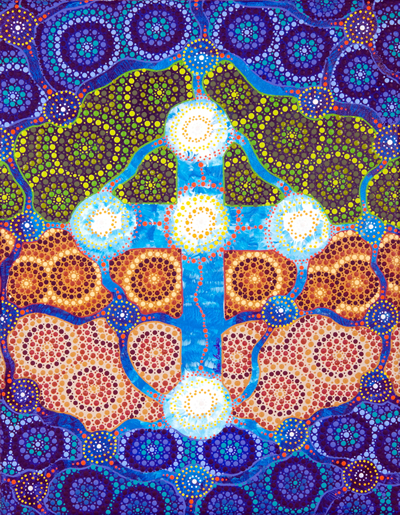
Australian Aboriginal Nativity Card

Please Note: All posts on this blog are intended for informational purposes only, not as an evaluation or endorsement of any artist, art form, organization or website.  If you have concerns about the accuracy of any information presented please contact the author at hmsarthistorian@gmail.com.


I recently came across this beautiful Christmas card by Australian Aboriginal artist Raechel Saunders at her Etsy shop. Raechel is a painter, illustrator, and ceramic artist. Her abstract Aboriginal art style is heavily inspired by her artist/pastor/father's artwork and teaching. You can see even more of her work at her personal website.

Friday, December 23, 2016

Indigenous Painting: Holy Spirit in This Land

Please Note: All posts on this blog are intended for informational purposes only, not as an evaluation or endorsement of any artist, art form, organization or website.  If you have concerns about the accuracy of any information presented please contact the author at hmsarthistorian@gmail.com.


Holy Spirit in This Land by Lisa Buxton, Aboriginal Education Adviser, from the Catholic Education Office Sydney.  The painting was created to depict the theme of the inaugural Indigenous Mass at St Mary's Cathedral for Sydney's Catholic schools in 2013.  

The aim of the Mass is to show respect towards Australia's first people and to celebrate the indigenous culture and build bridges between indigenous and non-indigenous Australians.

Monday, January 26, 2015

Artist Safina Stewart Speaks About Australia Day

Please Note: All posts on this blog are intended for informational purposes only, not as an evaluation or endorsement of any artist, art form, organization or website.  If you have concerns about the accuracy of any information presented please contact the author at hmsarthistorian@gmail.com.


Today, January 26, is Australia Day down under.  Wikipedia writes that Australia Day


is the official national day of Australia... it marks the anniversary of the 1788 arrival of the First Fleet of British Ships at Port Jackson, New South Wales, and raising of the Flag of Great Britain at that site by Governor Arthur Phillip... With community festivals, concerts and citizenship ceremonies, the day is celebrated in large and small communities and cities around the nation. Australia Day has become the biggest annual civic event in Australia.

So, it's something like America's July 4th celebration.  In this video from 2014, artist Safina Stewart shares her perspective on the holiday as an Aboriginal Australian and Christian.  I think what she says here is very powerful and something that most white Christians (around the world) don't often hear.  Her sentiments are probably very applicable to Native Americans in the U.S. as well.  There certainly is a need all over the world for Christians of different cultural backgrounds to love and support one another.  Few of us do that well, myself included.  But we can be thinking and praying about it, and try to take small practical steps towards others in a spirit of kindness and friendship (like she mentions in the video).  To see and read about Safina and her art, visit her website Art by Safina.


Saturday, July 12, 2014

Call for Entries: "Our Mob – God’s Story" Indigenous Christian Art Book

Please Note: All posts on this blog are intended for informational purposes only, not as an evaluation or endorsement of any artist, art form, organization or website.  If you have concerns about the accuracy of any information presented please contact the author at hmsarthistorian@gmail.com.

Birth of Jesus by Max Conlon has been featured in the project's promotional materials.
Conlon is also one of the book's selection committee members.

It's been nearly a month since I've posted, mainly due to an online class that ended in early June and lots of stuff to catch up on since then. Anyway, please check out a flyer here about the upcoming Indigenous Australian Christian art book that I posted about in 2013.  It's called Our Mob – God’s Story and is being produced by Bible Society Australia for publication in 2017.  They're asking for submissions of "paintings which tell Bible stories or depict Christian symbols" by Aboriginal and Torres Strait islander artists.  The deadline for entries is July 31 2014.

All proceeds from the sale of the book will aid in providing Bible translations into indigenous Australian heart languages.  The book's selection committee is made up entirely of Aboriginal Australians.

The hope for Our Mob – God’s Story is to show "the depth of spirituality among Indigenous Christians while showcasing their talent, and [to be] a creative means of engaging people with the gospel."  Click here for more about the book and one of its selection committee members, Christobel Mattingley.  For more about artist and selection committee member Max Conlon, click here.  

Tuesday, April 1, 2014

Wominjeka ("Welcome") by Safina Stewart

Please Note: All posts on this blog are intended for informational purposes only, not as an evaluation or endorsement of any artist, art form or organization.  If you have concerns about the accuracy of any information presented please contact the author at hmsarthistorian@gmail.com.


Wominjeka ("Welcome") by Safina Stewart,  2014. 184cm x 122cm

Australian Aboriginal Christian artist Safina Stewart recently completed another commissioned painting, this one for One Community Church near Melbourne, Australia.  The church asked Safina to create a painting that represented "authentic welcome."

Safina responded with Wominjeka, or "Welcome" in the language of the Wurundjeri people (upon whose land One Community Church stands).  Here is a description of the painting from the church's website:


The symbols she has chosen are time-honoured icons of the Wurundjeri people upon whose land One Community Church stands. The gum leaves are used in ‘Welcome to Country’ ceremonies. The Manna Gum, known for its resilience, symbolises hope, courage, perseverance, growth and life. The handprint signatures represent the unique identity each person brings to Christian community.  Their imperfect form recognises on the one hand each person’s brokenness, sadness, suffering and struggle. However, they also highlight God’s amazing grace that welcomes without condition or judgement. 
The central circles symbolise unity and connection within community and the strong, trusting, healthy and restored fellowship celebrated through generous, welcoming hospitality. The feeder creeks running into the large Yarra river symbolise the healing, refreshing and cleansing power available to all who respond to his invitation to come to him for rest.  Even in our brokenness He invites all to soak in His saving/healing River of Life. As the rivers run out beyond the borders of the painting, there is a reminder that as redeemed, commissioned ambassadors we too are to be Jesus’ welcomers beyond the familiar boundaries of our own ‘country’.

At the same link you can watch a short video of Safina discussing the inspiration behind the painting and the various parts of it, as well as listen to a downloadable podcast of her speaking about it (click here to go directly to the podcast link).  Here is the video:

Tuesday, March 18, 2014

Aboriginal Christian Painting of the Trinity and the People of God

Please Note: All posts on this blog are intended for informational purposes only, not as an evaluation or endorsement of any artist, art form or organization.  If you have concerns about the accuracy of any information presented please contact the author at hmsarthistorian@gmail.com.

Here's a beautiful Australian Aboriginal painting called "Wapirra Trinity" by Clarise Nampijinpa Poulson, posted at Matt Stone's blog, Curious Christian (an excellent blog with great posts and art– check it out!).  For a description of the painting and it's meaning, click on the image.  The link features an article called "The Impact of Christianity on Australian Indigenous Art" and includes artwork by other Australian Aboriginal artists as well.  The article begins by posing several questions, which then are addressed as the article continues:


"What enables Indigenous artists to create paintings with Christian themes, even though one of the primary characteristics of Indigenous art lies in the narrative connection to the artist's country in its special Indigenous sense? What enables Indigenous people, who in their own views of religion include neither guilt nor original sin, to become involved with Christianity? What understanding or interpretation do the artists have of the Christian elements in their paintings?"

Tuesday, October 29, 2013

Australian Aboriginal Artist Miriam-Rose Ungunmerr-Baumann Recognised with Educational Foundation

Miriam-Rose Ungunmerr-Baumann

NT News reports that Australian Aboriginal artist and educator Miriam-Rose Ungunmerr-Baumann, "who has an honorary PhD in education, has been made the chair of the new Miriam-Rose Foundation."  The foundation has recently been established to "raise money to help remote indigenous children get better access to education and learning opportunities, including by boarding in cities."

Uniya.com writes that "in 1998, Miriam-Rose was appointed a Member of the Order of Australia, for her services to Aboriginal education and art, and for services to the Nauiyu community having been for many years a member of the local community council, often in the role of President."

"Despite never attending secondary school, Miriam-Rose became the NT's first Indigenous school teacher and principal of St Francis Xavier in her home community. Influenced by her bush-tracker uncle, Miriam advocates teaching both western and traditional ways in Indigenous communities" (105.7 ABC Darwin).

Wednesday, September 11, 2013

Stained Glass Window at Yuendumu Baptist Church in Northern Territory, Australia

Stained glass window at Yuendumu Baptist Church in Northern Territory, Australia,
showing the Cross of Christ surrounded by the Dreamings of the various Warlpiri clan divisions.
Photo by Louise, 2009.

I'm doing more research on Ivan Jordan's book, Their Way: Towards an Indigenous Warlpiri Christianity, and found this image of a stained glass window at a church in the area where he and his wife Verl were missionaries from 1973 until c. 2000 (his ministry was centered in the church at Lajamanu).  The church was built in 1967 under the direction of Ivan's predecessor, Tom Fleming, who worked at Yuendumu from 1950-1975.  Ivan writes this about Tom and the window above:

The beautiful stained glass window in the Yuendumu church building with the cross in the centre of the various Dreaming designs of the Warlpiris, is further testimony to Tom's attitude.  The window reminds those entering the building that all people come into God's family through the cross of Christ.  It also reminds them that every person who comes into God's family comes as they are; not as a White person or Westerner, but as a truly Aboriginal person, and for the Warlpiris, they come as a member of their kinship group.  This approach of architecturally relating the people to God in a graphic way is similar to what has happened at other places such as Yirrkala and Maningrida, in Arnhem Land (148).

Click on the image above to see more photos by "Louise" from the church (including more artwork, though sometimes blurry).

Monday, July 22, 2013

Dot-painting tips for tourists draws MP's ire

Picture: Steve Strike.  Source: The Australian

The following news story from Australia is a warning for Christian workers and others about the divisions that can result when utilizing indigenous sacred art forms.  There were no Christian workers involved in this case, but it shows that participation in indigenous art forms by non-natives can sometimes create animosity among indigenous groups.  So, always be careful and preferably come alongside local believers when exploring the use of sacred art forms.

Friday, March 29, 2013

Milingimbi Easter panel

Milingimbi Easter panel, c.1965

From the National Gallery of Australia (link includes a video of the painting with the following spoken text, or click here):

Thursday, March 28, 2013

Maundy Thursday Art: Desert Eucharist by Linda Yunkata Syddick Napaltjarri

Desert Eucharist by Linda Syddick Napaltjarri

Wikipedia: "Linda Yunkata Syddick Napaltjarri (born c. 1937) is a Pintupi- and Pitjantjatjara- speaking Indigenous artist from Australia's Western Desert region. Her father was killed when she was young; her mother later married Shorty Lungkarta Tjungarrayi, an artist whose work was a significant influence on Linda Syddick's painting."

Artspeak Studio Gallery: "The fusion of Christianity and traditional culture is atypical of the Art of Linda Syddick, who is a deeply religious woman whose tribal world and Christian beliefs remain as one, as demonstrated in her unique paintings."

Cooee Aboriginal Art: "A deeply religious woman, her paintings reflect both her extensive knowledge of the Dreaming and her Christian beliefs. Besides these ‘crossover’ paintings, she paints Tingari Dreamings, her father’s Emu Dreamings and her mother’s Snake stories.  During the 1980’s Linda rose to prominence as an artist with a series of paintings that fused Christian stories with Aboriginal tradition, In attempting to show the link between Christian and Aboriginal creation stories she touched upon universal themes in her paintings that were executed in a traditional Pintupi style."

For a review of a group art show from 2005 called Holy Holy Holy that Linda participated in, click here.  The show explored "the impact of Christianity on Aboriginal people."

Tuesday, March 26, 2013

Four Easter Story Paintings by Australian Aboriginal Artist Linda Naparula Walker


Australian Aboriginal artist Linda Naparula Walker is a Warlpiri woman from Yuendumu Community in Central Australia.  Her father taught her to paint when she was a teenager.  He told her all the stories she could paint and share through her art.  Linda would travel all over Australia with her father, helping him do his ‘dots’ as she learnt from him.  Her own paintings have been featured in group art shows in Australia and the U.S.  Some of Linda's other paintings can be seen herehere and here.

Sunday, November 27, 2011

Artist Profile: Safina Stewart

Southern Cross Turtle by Safina Stewart

Safina Stewart is an Australian Indigenous Christian artist living in Melbourne, Australia.  Born in Auckland, New Zealand, but raised in the highlands of Papua New Guinea, Safina grew up with many multicultural experiences where she learned to follow Jesus from her missionary parents.  Her father is Australian with a Scottish heritage and her mother is a Torres Strait Islander and Queensland Aboriginal.  At the age 13 Safina returned to live in mainland Australia.

Monday, June 20, 2011

Book Review: Aboriginal Church Paintings


I recently came across a couple of articles on the web (here and here) that mentioned a new book called Aboriginal Church Art: Reflecting on Our Faith by Eugene Stockton and Terence O'Donnell.  So, of course, I immediately emailed the publisher (no online ordering site) and ordered a copy by check.  The publisher's representative was very helpful and sent a copy from Australia straight away.