Thursday, March 6, 2014

Mongolian Warrior Paintings #6-7

Please Note: All posts on this blog are intended for informational purposes only, not as an evaluation or endorsement of any artist, art form or organization.  If you have concerns about the accuracy of any information presented please contact the author at hmsarthistorian@gmail.com.

Here are the sixth and seventh paintings by Mongolian Christian artist Tumur-Ochir Gombojav.  To read about the entire group of these paintings and their cultural background, please click here.


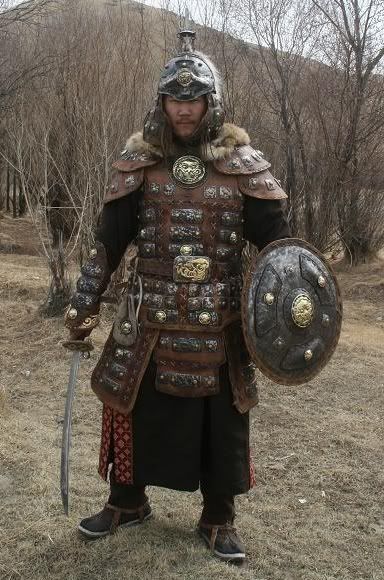
The Breastplate of Righteousness

Reproduction Mongolian Warrior Armor,
c. 1200-1300 A.D.


Feet Fitted With the Readiness That Comes From
the Gospel of Peace (trampling the "Toad of Greed";
note metal plates[?] on boots)

Mongolian plated boots, c. 15th-16th Century A.D.

Wednesday, March 5, 2014

Mongolian Warrior Paintings #4-5

Please Note: All posts on this blog are intended for informational purposes only, not as an evaluation or endorsement of any artist, art form or organization.  If you have concerns about the accuracy of any information presented please contact the author at hmsarthistorian@gmail.com.

The fourth and fifth paintings by Mongolian Christian artist Tumur-Ochir Gombojav.  To read more about the entire group of these paintings and their cultural background, please click here.


Our Struggle is Not Against Flesh and Blood, But Against the Powers
of This Dark World and Against the Spiritual Forces of Evil
#2

Mongol heavy cavalryman, 13th century.
Genghis Khan: The Exhibit.


The Belt of Truth

Mongolian belt with brasswork

Tuesday, March 4, 2014

Mongolian Warrior Paintings #2-3

Please Note: All posts on this blog are intended for informational purposes only, not as an evaluation or endorsement of any artist, art form or organization.  If you have concerns about the accuracy of any information presented please contact the author at hmsarthistorian@gmail.com.

Today we continue with the second and third of paintings by Mongolian Christian artist Tumur-Ochir Gombojav.  To read more about the entire group of these paintings and their cultural background, please click here.

Put On the Full Armor of God.

Our Struggle is Not Against Flesh and Blood, But Against the Powers
of This Dark World and Against the Spiritual Forces of Evil
#1


Corresponding art from historical sources:


A Timurid depiction of an Mongol archer, early 15th century.

One of Khubilai Khan's Mongol bodyguards, late 12th century

Monday, March 3, 2014

Mongolian Warrior Paintings Depict the Armor of God from Ephesians 6:10-20

Please Note: All posts on this blog are intended for informational purposes only, not as an evaluation or endorsement of any artist, art form or organization.  If you have concerns about the accuracy of any information presented please contact the author at hmsarthistorian@gmail.com.

My friend, Ariunaa, a Southeast Asian living in Mongolia, previously worked with me in order to facilitate the creation of a contextualized worship banner based on one of my bowl paintings (here and here).  She recently emailed me about a Mongolian Christian artist that had completed a series of contextualized paintings based on Ephesians 6:10-20, where Paul describes the whole armor of God.  Each picture includes a Bible verse in Mongol bichig (traditional Mongolian script).

The 57 year-old artist, Tumur-Ochir Gombojav, attends church at Itgeliin Bambai (Shield of Faith) in Ulaanbaatar, Mongolia.  Three years ago a friend of Tumur-Ochir's brought him to Itgeliin Bambai where he became a Christian, and as a result he now seeks to glorify God with his art.  Previously he attended art school in Mongolia from 1971-1975, and later after graduation attended the School of Fine Arts Academy in Saint Petersburg, Russia 1979-1986.

Monday, February 17, 2014

Ethnodoxology's Time is Here: How Engaging Local Artists Can Expand God’s Kingdom


Please check out this excellent interview with Brian Schrag, SIL International’s Ethnomusicology and Arts Coordinator.  Brian developed the World Arts program at the Graduate Institute of Applied Linguistics (GIAL) in Dallas, Texas, and is interviewed here by Robin Harris, the President of the International Council of Ethnodoxologists and Coordinator of the MA in World Arts program at GIAL.

In the interview, Brian explains what ethnodoxology is and why locally grounded artistic communication is so powerful for the expansion of the kingdom of God.  He goes on to describe the process of doing ethnodoxology in a community and the impact it can have for those people and for the Kingdom.

Here is an excerpt from the interview that gives a hint of the potential impact of ethnodoxology:

RPH: If we, the church, adopt the kind of approach you used in [Democratic Republic of Congo], what do you think will happen? 
BES: If ethnodoxology becomes the primary approach to growth in mission and worship: 
• Minority artists and their arts will be well integrated into their community’s church life.
• The church will become an engine for revitalization of minority arts and their communities, rather than a frequent contributor to their demise.
• Sharing of artistic resources in the church will move both from minority to majority cultures and vice versa.
• More artistic forms will be represented around God’s throne (Rev 7:9-12) and in his city (Rev 21:22-27).

Monday, February 10, 2014

OM Arts Incarnate 2014


Over the next few days, ten artists from eight countries will show up in Northern Italy for 3 months of discipleship, creativity and training in outreach called OM Arts International Training : Incarnate 2014.  Structured around 3 courses: “God’s Story,” “Your Story” and “10,000 Stories”, the program leads artists in personal transformation, helping them to develop an approach for art ministry that glorifies God and is cross-culturally effective.

Learning will happen through lecture, group discussion, reading, creative assignments, field trips and other practical activities.

Artists are led to authentic engagement with the people of the local community, church and arts scene. The people of these communities become the inspiration for creative response and collaboration throughout the program, culminating in a final exhibition and event.


Much studio time is given for students to develop their craft. Mentors for each art form will help the students apply their learning to their creative work.

Incarnate 2014 mixes all these ingredients and more so that artists can thrive at living the great commission.  Please be in prayer for this year's ten artists who will be participating 11 February - 3 May 2014.  For more information about the program, click here.  To get the latest updates about Incarnate 2014, sign up here, and to support Incarnate 2014 financially, click here.

Friday, February 7, 2014

Chinese Nestorian Headstone


THE LOTUS & THE CROSS: EAST-WEST CULTURAL EXCHANGE ALONG THE SILK ROAD 

This online exhibit replicates the exhibition of large-format photographs of stone tombstones from Fujian province in South China and stone crosses from Kerala state in South India was mounted in September 2007 in conjunction with the Lotus and Cross symposium.


Christian Headstone with Canopy
Yuan dynasty (1272—1368)
Quanzhou Maritime Museum
Ricci 20 KP 020 Z24

A canopy or parasol was used in ancient India to protect kings and other royals from the sun, and it subsequently became a symbol of power and prestige. It was natural to use a canopy in association with the Buddha as he had been a prince before attaining enlightenment. It can be seen in the early Buddhist art of India, and was transmitted to Central Asia and China where it appears, for example, at Dunhuang. A similar canopy to the one shown on this tombstone can be seen on a panel relief on the Eastern pagoda of the Kaiyuan Temple in Quanzhou, completed about 1250.

The discovery of the canopy’s presence on Christian tombstones of the Mongol period is quite remarkable, and yet explicable in the context of the multiculturalism of Quanzhou. The canopy has tassels or streamers dangling from it and protects the cross emerging from an open lotus flower.