Monday, April 7, 2014

Non-Western Historical Fashion

Please Note: All posts on this blog are intended for informational purposes only, not as an evaluation or endorsement of any artist, art form, organization or website.  If you have concerns about the accuracy of any information presented please contact the author at hmsarthistorian@gmail.com.


Rabari women can be easily identified by looking at their womenfolk,
who usually wear long black headscarves (lobadi) and distinctive heavy
brass earrings. They tattoo magical symbols on their necks, breasts and arms.

Hey fashion freaks: check out this website I found called Non-Western Historical Fashion for links to some cool indigenous textiles, clothing, jewelry, etc., plus a dose of very non-red state opinions (reader beware).  But definitely a great visual resource for nonwestern clothing.  And here's something for the guys:


Samurai helmet (kabuko) shaped like an octopus.
About 18th century, Japan

Thursday, April 3, 2014

Cherokee Dance Group Perform at UNC Asheville Rescheduled to April 8

Please Note: All posts on this blog are intended for informational purposes only, not as an evaluation or endorsement of any artist, art form or organization.  If you have concerns about the accuracy of any information presented please contact the author at hmsarthistorian@gmail.com.

The Warriors of AniKituhwa

NOTE - THE PERFORMANCE HAS BEEN POSTPONED UNTIL APRIL 8 DUE TO EXPECTED INCLEMENT WEATHER ON MARCH 25. THE PERFORMANCE WILL TAKE PLACE AT 12:30 P.M. ON THE QUAD.

POSTPONED UNTIL APRIL 8– If you are in the Asheville, NC area Tuesday, April 8th and can make it, don't miss this performance by the Warriors of AniKituhwa!

From the UNC-Asheville website:

The Warriors of AniKituhwa, Cherokee dance group and official cultural ambassadors for the Tribal Council of the Eastern Band of Cherokee Indians, will perform at 12:30 Tuesday, March 25 at UNC Asheville’s Main Quad. Their performance is free and open to the public. 
The Warriors of AniKituhwa educate audiences about Cherokee history and culture by performing Cherokee dances such as the Eagle Tail Dance, Beaver Hunting Dance and Friendship Dance, based on traditions that date back generations. They also perform a re-creation of the War Dance, using descriptions from the memoirs of Lt. Henry Timberlake, a colonial journalist who witnessed the dances, as well as music from songs recorded on wax cylinders by Cherokee tribal councilman Will West Long and anthropologist Frank Speck in the 1920s.

For additional information click here.

Tuesday, April 1, 2014

Wominjeka ("Welcome") by Safina Stewart

Please Note: All posts on this blog are intended for informational purposes only, not as an evaluation or endorsement of any artist, art form or organization.  If you have concerns about the accuracy of any information presented please contact the author at hmsarthistorian@gmail.com.


Wominjeka ("Welcome") by Safina Stewart,  2014. 184cm x 122cm

Australian Aboriginal Christian artist Safina Stewart recently completed another commissioned painting, this one for One Community Church near Melbourne, Australia.  The church asked Safina to create a painting that represented "authentic welcome."

Safina responded with Wominjeka, or "Welcome" in the language of the Wurundjeri people (upon whose land One Community Church stands).  Here is a description of the painting from the church's website:


The symbols she has chosen are time-honoured icons of the Wurundjeri people upon whose land One Community Church stands. The gum leaves are used in ‘Welcome to Country’ ceremonies. The Manna Gum, known for its resilience, symbolises hope, courage, perseverance, growth and life. The handprint signatures represent the unique identity each person brings to Christian community.  Their imperfect form recognises on the one hand each person’s brokenness, sadness, suffering and struggle. However, they also highlight God’s amazing grace that welcomes without condition or judgement. 
The central circles symbolise unity and connection within community and the strong, trusting, healthy and restored fellowship celebrated through generous, welcoming hospitality. The feeder creeks running into the large Yarra river symbolise the healing, refreshing and cleansing power available to all who respond to his invitation to come to him for rest.  Even in our brokenness He invites all to soak in His saving/healing River of Life. As the rivers run out beyond the borders of the painting, there is a reminder that as redeemed, commissioned ambassadors we too are to be Jesus’ welcomers beyond the familiar boundaries of our own ‘country’.

At the same link you can watch a short video of Safina discussing the inspiration behind the painting and the various parts of it, as well as listen to a downloadable podcast of her speaking about it (click here to go directly to the podcast link).  Here is the video:

Sunday, March 23, 2014

Cherokee Dance Group to Perform March 25 at UNC Asheville

Please Note: All posts on this blog are intended for informational purposes only, not as an evaluation or endorsement of any artist, art form or organization.  If you have concerns about the accuracy of any information presented please contact the author at hmsarthistorian@gmail.com.

The Warriors of AniKituhwa

If you are in the Asheville, NC area Tuesday, March 25 and can make it, don't miss this performance by the Warriors of AniKituhwa!

From the UNC-Asheville website:

The Warriors of AniKituhwa, Cherokee dance group and official cultural ambassadors for the Tribal Council of the Eastern Band of Cherokee Indians, will perform at 12:30 Tuesday, March 25 at UNC Asheville’s Main Quad. Their performance is free and open to the public. 
The Warriors of AniKituhwa educate audiences about Cherokee history and culture by performing Cherokee dances such as the Eagle Tail Dance, Beaver Hunting Dance and Friendship Dance, based on traditions that date back generations. They also perform a re-creation of the War Dance, using descriptions from the memoirs of Lt. Henry Timberlake, a colonial journalist who witnessed the dances, as well as music from songs recorded on wax cylinders by Cherokee tribal councilman Will West Long and anthropologist Frank Speck in the 1920s.

For additional information click here.

Tuesday, March 18, 2014

Aboriginal Christian Painting of the Trinity and the People of God

Please Note: All posts on this blog are intended for informational purposes only, not as an evaluation or endorsement of any artist, art form or organization.  If you have concerns about the accuracy of any information presented please contact the author at hmsarthistorian@gmail.com.

Here's a beautiful Australian Aboriginal painting called "Wapirra Trinity" by Clarise Nampijinpa Poulson, posted at Matt Stone's blog, Curious Christian (an excellent blog with great posts and art– check it out!).  For a description of the painting and it's meaning, click on the image.  The link features an article called "The Impact of Christianity on Australian Indigenous Art" and includes artwork by other Australian Aboriginal artists as well.  The article begins by posing several questions, which then are addressed as the article continues:


"What enables Indigenous artists to create paintings with Christian themes, even though one of the primary characteristics of Indigenous art lies in the narrative connection to the artist's country in its special Indigenous sense? What enables Indigenous people, who in their own views of religion include neither guilt nor original sin, to become involved with Christianity? What understanding or interpretation do the artists have of the Christian elements in their paintings?"

Sunday, March 9, 2014

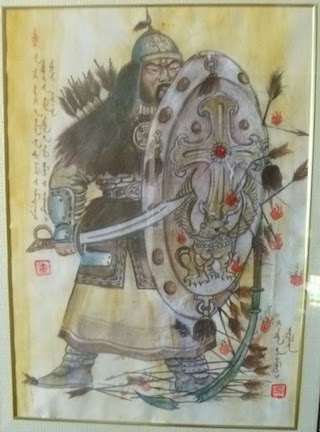
Mongolian Warrior Paintings #8-10

Please Note: All posts on this blog are intended for informational purposes only, not as an evaluation or endorsement of any artist, art form or organization.  If you have concerns about the accuracy of any information presented please contact the author at hmsarthistorian@gmail.com.

Today we finish with the last three paintings by Mongolian Christian artist Tumur-Ochir Gombojav.  To read more about the entire group of these paintings and their cultural background, please click here.


The Shield of Faith to Extinguish All the Flaming Arrows
of the Evil One

Mongol shield, 13th century.
Genghis Khan: The Exhibit.

Mongol shield, 13th century.
Genghis Khan: The Exhibit.


The Helmet of Salvation

Mongolian helmet, date unknown.

To see a licensed image of a modern reenactor at the Naadam Festival in Mongolia wearing a cross-emblazoned helmet similar to the one in the painting above, click here.

And lastly...
The Sword of the Spirit, Which is the Word of God
(the Mongolian sword is not double-edged, so the warrior
 wields two swords: the Old and the New Testaments)

Mongol Cavalry Saber, 13th-14th century, Genghis Khan: The Exhibit.

Mongol Cavalry Saber, 13th-14th century, Mongolian Military Museum.

Thursday, March 6, 2014

Mongolian Warrior Paintings #6-7

Please Note: All posts on this blog are intended for informational purposes only, not as an evaluation or endorsement of any artist, art form or organization.  If you have concerns about the accuracy of any information presented please contact the author at hmsarthistorian@gmail.com.

Here are the sixth and seventh paintings by Mongolian Christian artist Tumur-Ochir Gombojav.  To read about the entire group of these paintings and their cultural background, please click here.


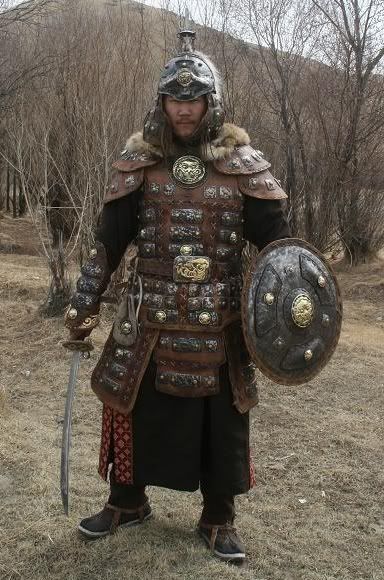
The Breastplate of Righteousness

Reproduction Mongolian Warrior Armor,
c. 1200-1300 A.D.


Feet Fitted With the Readiness That Comes From
the Gospel of Peace (trampling the "Toad of Greed";
note metal plates[?] on boots)

Mongolian plated boots, c. 15th-16th Century A.D.