Tuesday, June 19, 2012

Art as Culture: Preface and Chapter 1 Review

Back in March I wrote a brief post about Evelyn Payne Hatcher's book Art as Culture: An Introduction to the Anthropology of Art.  Afterwards I ordered a copy and promptly read the first chapter, but have not gotten beyond that as of yet.  However, what I've read so far has been very interesting, and I think that instead of trying to read the whole book and then write one review, I will review the chapters individually (or in groups perhaps) so that I can discuss more details and concepts throughout the book.  So in today's post I will begin with the book's preface, and then Chapter 1, "Contexts and Comparisons: The Anthropological Approach" (the first eight pages can be read here).

In her preface, Hatcher establishes the purpose of the book as "primarily to help provide a way for formulating questions concerning whatever aspect of the subject [art objects] is of interest, at whatever level the reader wishes to pursue it" (xi).  In order to assist the reader in this endeavor, she seeks to simply the multiplicity of theories surrounding the anthropological study of art and culture.  Hatcher rejects the idea of finding a single model to explain art in all societies, if that model is built upon only one viewpoint or way of looking at culture.  Rather,

one can perceive many theories and models as belonging to different categories, rather than as competing explanations... When various levels, aspects and viewpoints are sorted out in very basic terms, relationships between these different perceptions can emerge... Until the basic similarities are laid bare, the subtleties between different formulations of similar concepts make for confusion, misunderstanding, and unproductive controversy (xiv).

Sunday, June 10, 2012

New Terracotta Warriors Unearthed


Although not related to Christianity, here is a post by Hans van Roon at Mongols, Ancient China and the Silk Road about some of the latest terracotta warriors discovered in Xian, China, which show more traces of their original colors than previous figures.  I'm reposting it here in order to show that many examples of colorless art and architecture from the ancient world were originally brightly colored.  Something to keep in mind today as artists create new art based on ancient sculpture and the Gospel!

For more info about current excavations and the efforts to preserve the original colors of the warrior figures, check out this article at National Geographic as well as their recent photo gallery of painted warrior details.  The article explains how the original colors crumble from the terracotta surfaces within four minutes of excavation– "vibrant pieces of history lost in the time it takes to boil an egg."  So finding a way to immediately stabilize them was imperative.

The article is also accompanied by this short "fly by" video showing a reconstruction of the warriors at Xian with their vibrant colors intact:

Monday, May 28, 2012

Guatemalan Painter Manuel Reanda


Manuel Reanda is a self -taught Tzutujil painter who lives in Santiago Atitlan, Guatemala.  Manuel was born in 1948 and, though he was orphaned at six years of age, he had already begun drawing on the walls of his home with pieces of charcoal each day before going to school.

Manuel committed himself to a lifelong pursuit after finishing elementary school.  During this formative period of his life, he apprenticed for five years under the city's first "master" painter, Juan Sisay.  As an adult he studied mural painting in Mexico City with Juan O’Gorman, a student of the famous Mexican muralist Diego Rivera.  In the years since, he has passed on his knowledge of painting to many students of various ages.

Sunday, May 20, 2012

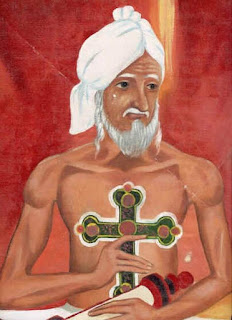
A Brief History of Visual Contextualization in India Part 4: Saint Thomas Christians

For this installment in my series "A Brief History of Visual Contextualization in India," I'll be discussing India's first Christian community, the Saint Thomas Christians (or "Nasrani").  Saint Thomas Christians traditionally live in the southwestern coastal state of Kerala and descend from a union of the local Indian population with a Jewish diaspora community, who had become Christians in the earliest days of the faith.  The Saint Thomas denominations use a Syriac liturgy in their church services and trace their spiritual heritage back to the assumed arrival of the Apostle Thomas ("Doubting Thomas") in southern India in 52 A.D.  In the third century, Nestorian Christian missionaries from the Church of the East in Persia began to settle in Kerala and organize the churches there according to their beliefs and liturgy.  Later in 1665, due to religious pressure from Portugese Catholics, the Saint Thomas Christians began to split into various factions along Catholic/Nestorian lines.  Today, this schism has resulted in several different Saint Thomas denominations, including Nestorian, Catholic, Orthodox, and even (since 1961) Evangelical!

Tuesday, May 15, 2012

Headstone with Lotus and Cross


While I'm slowwwwly writing the next post on my series A Brief History of Visual Contextualization in India, here's a cool image from the USF Ricci Institute for Chinese-Western Cultural History that I came across showing a beautiful Christian headstone from China.  It dates from the Yuan dynasty (1272—1368) and is now located in the Quanzhou Maritime Museum.  The caption reads:
Headstone showing a cross on a lotus flower and a cloud design set within a plain border following a curved outline. This basic design is repeated extensively in the Christian monuments dated to this period, although its iconographic import is unknown.

Wednesday, May 9, 2012

Mehindi Job Training in South Asia Uses Bible Stories


I recently came across the following blog entry by a Christian worker in South Asia, Lucy Chilton (not her real name).  She describes her use of henna/mehindi designs inspired by the Bible while giving job training to local women at a beauty salon school and sewing center.  If you are a lady who is interested in this art form, and wonder how it could be used to communicate the Gospel in South Asia or anywhere in North Africa or the Middle East, I suggest you read on.  For the rest of you, please read on anyway and rejoice that God is using cultural art forms to draw his children to Himself!

You can also check out my earlier post on the use of some of these same henna/mehindi designs by another missionary here.

Here is Lucy's post:

Tuesday, May 1, 2012

Engelbert Mveng: A Theology of Life Expressed in Art


Eighth Station of the Cross

Engelbert Mveng was born in 1930 near Yaoundé, Cameroon, to Presbyterian parents. He eventually became a Jesuit priest, as well as a historian, poet, artist, philosopher, and theologian. ArtWay.eu, a website that seeks to open up the world of the visual arts to interested Christians, writes that “Father Mveng studied the aesthetics of African arts and published his findings in numerous books and articles. ... His teaching was based on what he called the universal rules of African art. As a historian and theologian he made a great contribution to the study of African culture and history, especially in the realms of cultural and religious anthropology and iconology.”