Showing posts sorted by date for query india. Sort by relevance Show all posts

Monday, October 26, 2015

The Times of India: Widow of artiste Angelo da Fonseca passes away

Please Note: All posts on this blog are intended for informational purposes only, not as an evaluation or endorsement of any artist, art form, organization or website.  If you have concerns about the accuracy of any information presented please contact the author at hmsarthistorian@gmail.com.


From Sep 6, 2015:

Panaji: Ivy Muriel da Fonseca, widow of the late Indian Christian Cultural Renaissance artiste Angelo da Fonseca, passed away on Tuesday in Pune after a brief illness, said family sources. She was 87... Known to be an iron lady amongst friends, Fonseca Miss: as she was popularly known amongst her students, lived life on her terms. 

Read the rest of the article here.

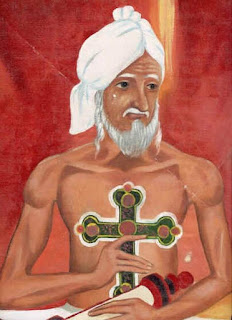
One admirer of Ivy posted the painting above (of her I assume, by her husband).


Monday, December 15, 2014

"Challenges in Conducting a Christian Art Exhibition in India" by Paul Kattukaran

Please Note: All posts on this blog are intended for informational purposes only, not as an evaluation or endorsement of any artist, art form, organization or website.  If you have concerns about the accuracy of any information presented please contact the author at hmsarthistorian@gmail.com.

The coordinator of Indian Christian Artists’ Forum, Art-i, Fr Paul Kattukaran (r)
presents an Indian image of Christ "My Guru" done by the late Goan artist
Angelo da Fonseca to Archbishop of Goa and Daman Filipe Neri Ferrao as a
token of inculturating Christian faith in India.

For reflections on the challenges that have faced the Indian Christian Art Exhibition mentioned in my last entry, click here.  The post's author is Paul Kattukaran, the Coordinator of the Indian Christian Artists’ Forum (Art-i).  For a news story about the opening of the exhibition (pictured above), click here.

Despite several setbacks, Kattukaran writes:

With all the challenges, the exhibition of Indian Christian Art in Old Goa is a success on different counts; first of all most Goan Christians and many at the national level came to know of the exhibition through the print media and internet, especially UCAN news. Secondly, this exhibition inaugurated and blessed by the Archbishop of Goa has become a stepping stone for Christian Art ministry in Goa and India.

Thursday, November 27, 2014

Indian Christian Art Exhibition Opens in Goa, India

Please Note: All posts on this blog are intended for informational purposes only, not as an evaluation or endorsement of any artist, art form, organization or website.  If you have concerns about the accuracy of any information presented please contact the author at hmsarthistorian@gmail.com.

Angelo da Fonseca, Ecce Homo. 33x48cm

From the Times of India:
Goan artists bridged Christianity and eastern religions: ArchbishopTNN | Nov 26, 2014, 02.13AM IST 
OLD GOA: Archbishop of Goa and Daman Filipe Neri Ferrao inaugurated the Indian Christian Art Exhibition at Our Lady of Mount Carmel Archiepiscopal palace chapel, Se Cathedral premises, Old Goa. 
"This inter-religious dialogue was actively promoted by the likes of Angelo da Fonseca and Angela Trindade, both from Goa through their art, a bridge of understanding between Christianity and eastern, particularly, Indian religions," the archbishop said.  
The exhibition highlights the images created by the late Goan artists Angelo da Fonseca and Angela Trindade, apart from Alfred Thomas, Sr Genevieve SMMI and Sr Claire SMMI. The exhibition is conducted by Art-i, Christian Artists' Forum, Art-i established by the Office for Social Communications, Catholic Bishops' Conference of India, Delhi.
Fr Dominic Alvares SFX welcoming the archbishop and the dignitaries, said that the Indian Christian Artists' Forum has found a great patron in Ferrao in promoting the Indian images of Christ and the Goa archdiocese should lead other dioceses of India in promoting Indian Christian Art.
The co-ordinator of Indian Christian Artists' Forum, Art-i, Fr Paul Kattukaran presented an Indian image of Christ "My Guru" done by the late Goan artist Angelo da Fonseca as a token of inculturating Christian faith in India.
The exhibition will be open from 9am to 7pm everyday till the last day of the Exposition of the Sacred Relics of Saint Francis Xavier; January 4, 2015.

Tuesday, October 14, 2014

Angelo da Fonseca: Portrait of an Eclectic Genius

Please Note: All posts on this blog are intended for informational purposes only, not as an evaluation or endorsement of any artist, art form, organization or website.  If you have concerns about the accuracy of any information presented please contact the author at
hmsarthistorian@gmail.com.


Vivek Menezes reviews an article by Rupert Arrowsmith in the current issue of Art India magazine about the legacy of one of India's greatest Christian artists, Angelo da Fonseca.

Menezes writes:

Until his death in 1967, [da Fonseca] painstakingly created a magnificent oeuvre of uniquely cross-cultural paintings that are among the most remarkable contributions to 20th century art from any painter, anywhere in the world. 
But until 2014, the artist's reputation never caught up to his achievement. As Arrowsmith notes in 'Portrait of an Eclectic Genius', "it is very telling that Angelo da Fonseca...has needed to wait until this year for his first ever inclusion in a survey of the Indian 20th century icons."

Sunday, September 7, 2014

Indian Christian Art by Brojoe Joseph

Please Note: All posts on this blog are intended for informational purposes only, not as an evaluation or endorsement of any artist, art form, organization or website.  If you have concerns about the accuracy of any information presented please contact the author at hmsarthistorian@gmail.com.

Below are some beautiful examples of Christian artwork by Indian artist Brojoe Joseph (perhaps his student work).  You can find more of his paintings at his blog, Indian Christian Art, which features an Introduction section where he briefly explains inculturation, as well as Christianity in India and various styles of Indian painting.


I Am the Light of the World

Supper

Thursday, April 17, 2014

The Last Supper by Jamini Roy

Please Note: All posts on this blog are intended for informational purposes only, not as an evaluation or endorsement of any artist, art form, organization or website.  If you have concerns about the accuracy of any information presented please contact the author at hmsarthistorian@gmail.com.

The Last Supper by Jamini Roy, c.1937–1940. Oil on canvas, 61 x 183 cm

From the Victoria and Albert Museum:

This work represents an instance of the artist's early fascination for Christian themes.
The painting depicts the twelve apostles in profile, six stand in the foreground and six in the background; Christ, is the only figure depicted in full frontal view. All the figures, have very large eyes, a characteristic feature of Jamini Roy's work. 
Jamini Roy (1887-1972) was one of the most important [non-Christian] artists of the modern period in India, drawing on the popular and folk traditions of rural Bengal for his inspiration. He developed his own personal style which was characterised by bold lines and flat use of colour. He used indigenous materials, including lamp black for the outline drawing, 7 basic colours (Indian red, yellow ochre, cadmium green, vermilion, grey, blue and white), which he applied with organic tempera, earth and mineral pigments to homemade canvas spun with fabric. His paintings can be divided into three main themes: the everyday life of rural Bengal, particularly the women of the aboriginal Santhal community, Hindu mythological subjects and Christian imagery.


Friday, February 7, 2014

Chinese Nestorian Headstone


THE LOTUS & THE CROSS: EAST-WEST CULTURAL EXCHANGE ALONG THE SILK ROAD 

This online exhibit replicates the exhibition of large-format photographs of stone tombstones from Fujian province in South China and stone crosses from Kerala state in South India was mounted in September 2007 in conjunction with the Lotus and Cross symposium.


Christian Headstone with Canopy
Yuan dynasty (1272—1368)
Quanzhou Maritime Museum
Ricci 20 KP 020 Z24

A canopy or parasol was used in ancient India to protect kings and other royals from the sun, and it subsequently became a symbol of power and prestige. It was natural to use a canopy in association with the Buddha as he had been a prince before attaining enlightenment. It can be seen in the early Buddhist art of India, and was transmitted to Central Asia and China where it appears, for example, at Dunhuang. A similar canopy to the one shown on this tombstone can be seen on a panel relief on the Eastern pagoda of the Kaiyuan Temple in Quanzhou, completed about 1250.

The discovery of the canopy’s presence on Christian tombstones of the Mongol period is quite remarkable, and yet explicable in the context of the multiculturalism of Quanzhou. The canopy has tassels or streamers dangling from it and protects the cross emerging from an open lotus flower.

Monday, November 18, 2013

Mehndi-style Nativity by Marcia Carole

The Nativity, pen and ink, watercolor by Marcia Carole
Artist/missionary Marcia Carole is working on a series of watercolor and mehndi Christmas cards based on her travels in India and study of mehndi/henna designs.  Above is the first one of the series, The Nativity.  She writes,

I am working on a series of watercolor and mehndi Christmas cards. I jumped right in with creating the nativity scene. Some of the piece developed around the flow of the watercolor. I used lots of flowering lotus blossoms representing the flowering of God's plan to recuse us through Jesus. I tried to also portray a cave, the barn of sorts, for the setting, and the unusual star assigned to mark the spot where the savior arrived.

The Nativity is beautiful and I can't wait to see the others in the series!  Check out her blog for future images and ordering info.  You can also order 11x14 giclee prints of her other recent mehndi painting, God's Story:


God's Story, acrylic on canvas, by Marcia Carole

Monday, November 4, 2013

Diwali 2013

From Reuters: Hindu women arrange oil lamps and flowers around a "Rangoli",
a traditional pattern made from coloured powders, during the celebrations ahead
of the Hindu festival of Diwali in the western Indian city of Ahmedabad [on]
November 1, 2013. Diwali, the annual festival of lights will be celebrated across
the country on November 3.

Sunday marked the beginning of the 5-day Northern Indian Hindu festival of Diwali, or the Festival of Lights (in South India it is called Deepavali).  Like Dashain in Nepal and Navratri in India, Diwali celebrates to victory of the Good over the Evil and Light over Darkness.  On the first day of Diwali, part of the festivities include drawing designs called rangolis on the ground in front of the entrance to one's home, as a form of welcome to the Goddess of Wealth and Prosperity, Lakshmi.  Here is my own version of a Christocentric Rangoli that I've posted about previously:


 [A rangoli is] meant to be sacred welcoming [area] for the Hindu deities" (Wikipedia).  This one shows the pierced feet of Jesus in the middle, welcoming Him into one's home.  John 1:1-5 tells us,

In the beginning was the Word, and the Word was with God, and the Word was God. He was in the beginning with God. All things were made through him, and without him was not any thing made that was made. In him was life, and the life was the light of men. The light shines in the darkness, and the darkness has not overcome it.

This week may Christ's light shine in our hearts and be made manifest in our lives through His Holy Spirit!  May His Gospel speak to others through us as we welcome Him each day.  Pray for Hindus throughout the world that Christ would speak to their hearts during this festival and reveal Himself to them as the true Light of the World who has come to save us.


Monday, September 2, 2013

Jesus Washing His Disciples' Feet by Hindu artist Bhanu Dudhat

Jesus Washing His Disciples' Feet by Bhanu Dudhat, 30" X 24" Acrylic on Canvas
Take a look at this interesting folk-style painting by Hindu artist Bhanu Dudhat of India.  You can see more of his paintings here (26 total).  The paintings are great, though at least one is bit off on the details– the Last Supper has 13 disciples!  Overall, however, they are a pleasure to see.  There is also a long scroll painting showing many scenes from the Old Testament (click here, or here for the entire image at once).

According to Bhanu's biography, he is a Hindu ("He has full devotion to Lord Shiva. He believes Lord Shiva as the source of motivation").  Unfortunately, his biography is also long, rambling and badly written in English.  So I would suggest that you stick to browsing the artwork by Bhanu and his wife, Prabha– whose Hindu paintings are almost identical in style to her husband's biblical paintings (I'm not sure which one developed the folk style first, as Bhanu paints contemporary abstracts as well).  The folk style of the biblical and Hindu paintings may have begun with Bhanu's mother, who (according to Bhanu's biography) also painted.  If you want to slog through the biography to figure it out for yourself, go for it!

Wednesday, August 21, 2013

Colorized Mehndi Tree Of Life by Marcia Carole


Here is the watercolor version of a pen and ink drawing by Marcia Carole, who recently returned from a trip to India.  She and friends from an English Institute in Varanasi painted a black and white mural of this same image while she was there.  You can see the mural here.

Here is Marcia's description of the tree's symbolism:

In the base or root system, I have symbols that represent creation - sun, moon, stars, fish, birds, mountains and water, Adam and Eve, the fruit(apple) is connected to 2 hearts with the symbol for Jesus in the trunk. The stars reappear as Abraham's promise, then a symbol with 12 swirls representing the 12 tribes. and life with the leaves going up the trunk. The Holy Spirit is the flame symbol in the branches, with fruit - heart leaves, flowing out of the flame. New life in Jesus produces healing from sin and death, so the flowering areas of the tree. I have the 12 disciples in there and early church.

You can read more about the watercolor version at her blog, The Creative Call.

Monday, August 5, 2013

Mehndi Tree Of Life by Marcia Carole

Tree Of Life, Pen and Ink, by Marcia Carole

Check out this wonderful pen and ink drawing by Marcia Carole, who is currently on a trip to India.  Marcia uses her talents to create collaged stories. She also helps others share their stories through collaged pages, story ropes & story tags.  You can read more about Marcia's ministry at her blog, The Creative Call.

Tuesday, November 13, 2012

Diwali 2012


Today marks the beginning of the 5-day Northern Indian Hindu festival of Diwali, or the Festival of Lights (in South India it is called Deepavali).  Like Dashain in Nepal and Navratri in India, Diwali celebrates to victory of the Good over the Evil and Light over Darkness.  On the first day of Diwali, part of the festivities include drawing designs called rangolis on the ground in front of the entrance to one's home, as a form of welcome to the Goddess of Wealth and Prosperity, Lakshmi.  This brought to mind another painting of mine...

Tuesday, October 23, 2012

A Visually Contextualized Reflection on a Hindu Festival

Last week I posted about the 2012 Dashain Prayer Book produced by Cody C. Lorance, which used a rangoli painting of mine on the cover.  As I looked into the Hindu festival of Dashain, I read that it is focused on the goddess Durga.  I confess that I've only lightly researched Dashain, and a related festival in India called Durga Puja, the "largest outdoor art festival on earth" (October 20-24).  Durga Puja takes place during the last several days of Navratri, another Hindu festival.

In any case, I think that the main point of each Durga festival is the celebration of the victory of Good over Evil, in the form of the Durga's victory over the evil buffalo demon Mahishasura.  Unfortunately, this celebration of Good conquering Evil is ironic because it is spiritually a very dark and oppressive time when idols are fervently worshipped and the Giver of Life is unknown or ignored.

Seeing this image of Durga slaying the buffalo demon reminded me of another Hindu-style painting I once did called Jesus' Work on the Cross:


Jesus' Work on the Cross

I have no idea how this painting would be interpreted by Hindus, but my intent was to show the purpose of Jesus' sacrifice for our sins without simply showing him nailed to the cross.  And besides, the image of Jesus kicking Satan's tail has always been a favorite subject of mine!  Here Jesus spears Satan through the neck, effectively "crushing his head," while Satan "strikes" Jesus in the heel (Genesis 3:15).  Jesus wears a crown that symbolizes his divine kingship over heaven and earth.  The flaming halo around his head symbolizes the presence of the Holy Spirit upon him.

This image depicts the ultimate triumph of Good over Evil through the sacrifice of Jesus Christ, who is motivated by his love for a lost world.  He didn't simply slay a demon; he defeated the King of the demons!  Of course, I suppose that it is Jesus' resurrection that confirmed his victory over Satan and Death, but that will have to wait for another painting.

Monday, September 24, 2012

A Brief History of Visual Contextualization in India: A.D. Thomas


The Transfiguration by A.D. Thomas

Alfred David Thomas (1907-1989) was an Anglican Indian who studied at the Lucknow Art School in Santiniketan, where he studied under Bireswar Sen and Nandalal Bose.  Sen himself was influenced by French book illustrator Edmund Dulac, who produced illustrations for children's classics such as The Arabian Nights, Sleeping Beauty, and Stories from Hans Christian Andersen, among others (his work is really great!).  Thomas later attended Visva Bharati University under Rabindranath's nephew, Abanindranath Tagore (the father of modern Indian art), and also studied in Florence, Italy.  He married in Italy and eventually moved to England where he lived until his death in 1989.

Monday, September 10, 2012

A Brief History of Visual Contextualization in India: The Bengal Renaissance and the Birth of Modern Indian Christian Art

Hindostan or British India map, c.1864.

Continuing in my intermittent series on visual contextualization in India, I want to give an overview on the Bengal Renaissance and its influence on 20th century Indian Christian artists.

Orientalist official of the
East India Company (circa 1760)
After the decline of the Mugal Empire in the mid-17th century, India came under the rule of various regional leaders called rajas.  About a century later, the privately-funded British East India Company took control over large areas of India, exporting cotton, silk, indigo dye, salt, saltpetre, tea and opium to Britain and Europe.  It eventually ruled over "India with its own private army, exercising military power and assuming administrative functions... In the modern era, its history is strongly associated with corporate abuse, colonialism, exploitation, and monopoly power."  It was absorbed into the British government's direct control in 1874.

Sunday, May 20, 2012

A Brief History of Visual Contextualization in India Part 4: Saint Thomas Christians

For this installment in my series "A Brief History of Visual Contextualization in India," I'll be discussing India's first Christian community, the Saint Thomas Christians (or "Nasrani").  Saint Thomas Christians traditionally live in the southwestern coastal state of Kerala and descend from a union of the local Indian population with a Jewish diaspora community, who had become Christians in the earliest days of the faith.  The Saint Thomas denominations use a Syriac liturgy in their church services and trace their spiritual heritage back to the assumed arrival of the Apostle Thomas ("Doubting Thomas") in southern India in 52 A.D.  In the third century, Nestorian Christian missionaries from the Church of the East in Persia began to settle in Kerala and organize the churches there according to their beliefs and liturgy.  Later in 1665, due to religious pressure from Portugese Catholics, the Saint Thomas Christians began to split into various factions along Catholic/Nestorian lines.  Today, this schism has resulted in several different Saint Thomas denominations, including Nestorian, Catholic, Orthodox, and even (since 1961) Evangelical!

Tuesday, May 15, 2012

Headstone with Lotus and Cross


While I'm slowwwwly writing the next post on my series A Brief History of Visual Contextualization in India, here's a cool image from the USF Ricci Institute for Chinese-Western Cultural History that I came across showing a beautiful Christian headstone from China.  It dates from the Yuan dynasty (1272—1368) and is now located in the Quanzhou Maritime Museum.  The caption reads:
Headstone showing a cross on a lotus flower and a cloud design set within a plain border following a curved outline. This basic design is repeated extensively in the Christian monuments dated to this period, although its iconographic import is unknown.

Monday, April 16, 2012

A Brief History of Visual Contextualization in India: Mughal Art

Christ as Salvator Mundi, 17th century.

Continuing with my series on visual contextualization in Indian art, I'll now turn to a another chapter in India's art history: Mughal Art.  The Mughal Empire was an Islamic ruling power in India from 1526-1858, although its "classic period" lasted from 1556-1707.  At its height, it controlled most of India, and parts of Pakistan, Bangladesh, and Afghanistan.  Besides trusty Wikipedia, I also will also be referring to Crossing Cultural Frontiers: Biblical Themes in Mughal Paintings by Som Prakash Verma (or more information about the book, see Amazon).

Saturday, March 3, 2012

A Brief History of Visual Contextualization in India: Hindu Art

Krishna Flirting with the Gopis, c. 1780–1820

As I stated in my last post in this series, both Hindu and Buddhist art in India grew indirectly out the Indus Valley/Harrapan civilization (3300–1300 BC), with each religion developing its own styles and subject matter.  Buddhist art came to prominence first, around the first century BC, and continued to be prominent in India through the 16th century AD.